

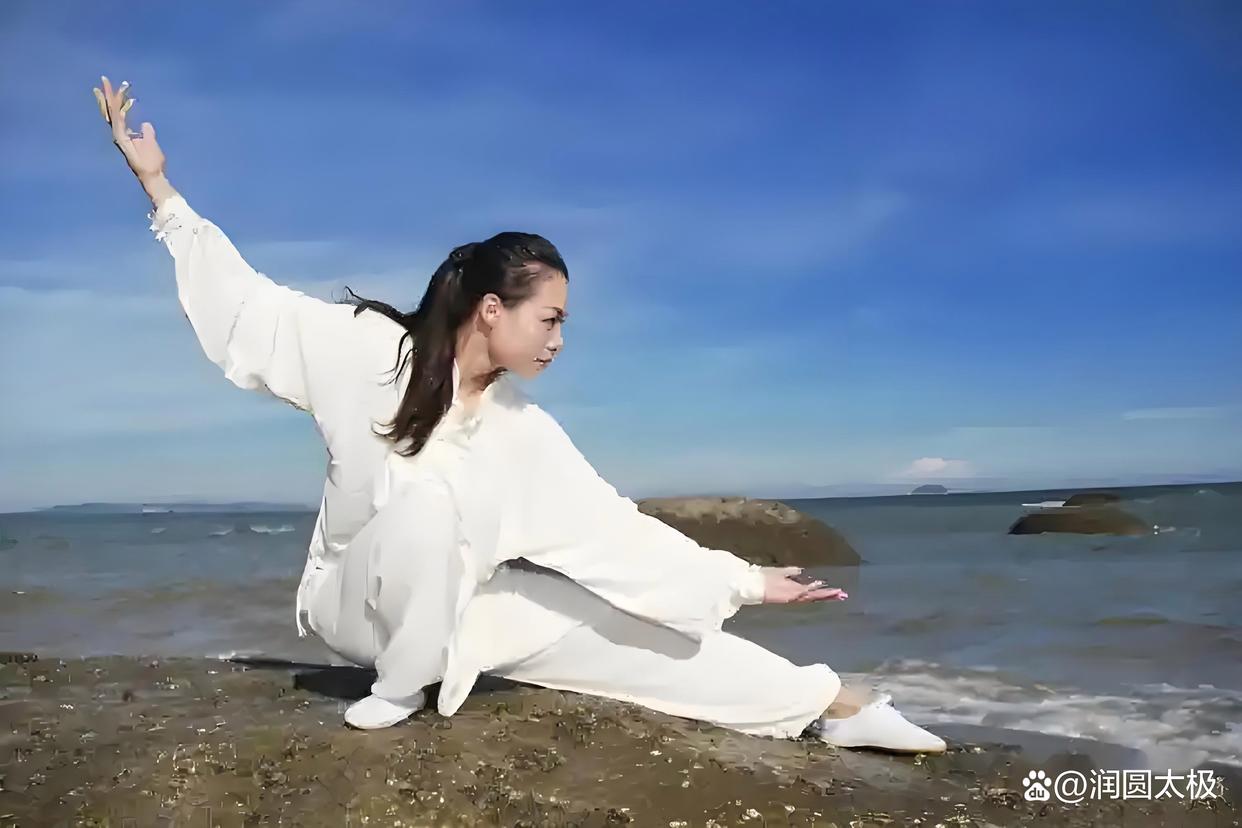
You’ve likely heard of Dong Jin (Understanding Energy), but the concept of Zhi Jin (Knowing Energy) remains far less familiar to most Tai Chi practitioners. Let’s start from the basics, tracing the foundational skills that underpin both concepts and uncovering the subtle yet profound differences between them.
In Tai Chi Chuan, the journey from intermediate practice to mastery is marked by the cultivation of distinct “jin” (勁) – refined energies that govern how a practitioner interacts with force. Four core skills form the bedrock of this progression:
- Ting Jin (聽勁) – Listening Energy: The ability to sense an opponent’s force and intent through heightened tactile awareness.
- Zhan Jin (粘勁) – Sticking Energy: Maintaining continuous physical contact to control an opponent’s movement trajectory.
- Sui Jin (隨勁) – Following Energy: Adapting seamlessly to an opponent’s shifts, whether in contact or at a distance, by matching their rhythm without resistance.
- Nian Jin (黏勁) – Adhering Energy: A more intimate, responsive form of sticking energy that locks into an opponent’s force to guide their actions subtly.
These four skills operate in a cyclical, mutually reinforcing loop: Ting deepens Nian, and Nian enhances Ting. Together, they create a feedback system that sharpens a practitioner’s ability to read and manipulate force.
A key distinction lies between Sui and Nian: Sui Jin prioritizes adapting to an opponent’s intent and timing, even without direct physical contact. Nian Jin, by contrast, demands constant touch – it is through sustained connection that the practitioner gains precise control over the opponent’s force.
Mastery of these four skills culminates in Hua Jin (化勁) – Neutralizing Energy – the ability to redirect incoming force effortlessly, turning an opponent’s momentum against them without resistance. True Hua Jin is not just the sum of Ting, Zhan, Sui, and Nian; it requires an intuitive grasp of an opponent’s structural weaknesses, movement patterns, and energy flow. This integrated understanding is what Tai Chi defines as Dong Jin (懂勁,Understanding Energy).
Dong Jin (懂勁,Understanding Energy) is the capacity to perceive, interpret, and respond to an opponent’s force dynamics with conscious precision. It is a well-recognized milestone in Tai Chi training – one that allows practitioners to move beyond reactive techniques and into strategic, intentional engagement. At this stage, a practitioner can analyze an opponent’s movements, anticipate their attacks, and deploy neutralizing or countering forces with deliberate skill.
Yet beyond Dong Jin and Hua Jin lies a rarer, more advanced state of mastery: Zhi Jin (知勁,Knowing Energy). While both concepts center on perceiving and manipulating force, they differ dramatically in depth, instinctiveness, and the level of conscious effort required – marking a clear divide between intentional understanding and embodied mastery.
Defining Zhi Jin (知勁,Knowing Energy)
If Dong Jin is about consciously recognizing force dynamics to formulate responses, Zhi Jin is about instinctively embodying force interactions to act without thought. It is a state of subconscious mastery where the practitioner no longer needs to analyze an opponent’s movements – they simply know what is happening, and how to respond, in the blink of an eye.
Zhi Jin transcends deliberate technique. It is the seamless fusion of “Yi (intent) leads, Qi (vital energy) follows, and Jin (refined force) manifests” – a state where the body responds to force as naturally as breathing.
Dong Jin vs. Zhi Jin: A Comparative Analysis
A practitioner with strong Dong Jin can accurately read an opponent’s attack direction, gauge their force intensity, and select the optimal neutralizing strategy. But their responses still involve a split second of conscious processing – a deliberate bridge between perception and action.
A practitioner who has attained Zhi Jin, by contrast, manipulates an opponent’s structure and energy as if moving a part of their own body. There is no gap between sensing and acting; responses are instantaneous, fluid, and entirely automatic.
At its core, Dong Jin is conscious understanding, while Zhi Jin is unconscious mastery.
| Aspect | Dong Jin (懂勁,Understanding Energy) | Zhi Jin (知勁,Knowing Energy) |
|---|---|---|
| Cognitive Process | Conscious, analytical, deliberate | Subconscious, intuitive, automatic |
| Reaction Speed | Requires momentary processing | Instant, seamless, no lag |
| Adaptability | Adaptive with strategic thought | Fully fluid, no hesitation |
| Training Stage | Intermediate, developmental milestone | Advanced, refined mastery |
| Awareness Level | Externally observed and intellectually grasped | Deeply internalized, embodied |
| Dependence on Contact | Relies on touch and visual observation | Minimal – works before full engagement |
Practical Application: Push Hands & Combat
In practical scenarios – whether push hands practice or real combat – the gap between Dong Jin and Zhi Jin lies in the integration of skill and body.
A practitioner with Dong Jin can detect an opponent’s weight shifts, anticipate their next move, and adjust their posture to neutralize or counter. But this process still involves a subtle, conscious calibration – a mental check to ensure technique aligns with the situation.
A practitioner with Zhi Jin needs no anticipation. They respond in the exact moment of contact (or even before) without conscious effort. To off-balance an opponent, they do not “choose” a technique; they make a slight, instinctive adjustment, and the opponent’s body naturally collapses into imbalance. To strike, they do not analyze posture or timing; they deliver force with pinpoint precision, guided entirely by embodied awareness.
Zhi Jin: A State of Being, Not a Technique
Dong Jin is a critical step in mastering force and structure, but Zhi Jin is the ultimate goal of Tai Chi practice – a state where force interactions are understood so deeply that conscious thought falls away entirely. This transition mirrors the Daoist principle of returning to naturalness: first, you learn the rules of structure and mechanics; then, you internalize them; finally, you transcend them to move with effortless spontaneity.
A master of Zhi Jin does not “fight” with techniques. They adapt instinctively to the present moment, their actions arising not from analysis, but from an inherent knowing. The journey from Dong Jin to Zhi Jin is a progression from doing to being – where every response is spontaneous, every movement is natural, and every action is perfectly aligned with the flow of force.
At the level of Zhi Jin, the practitioner does not chase control over an opponent. Instead, they maintain a state of relaxed readiness, where their body naturally meets every force with the optimal response. Sensitivity, adherence, following, and issuing cease to be separate skills; they become a single, seamless expression of embodied awareness.
Zhi Jin is not about reacting correctly. It is about being in a state where correct action happens on its own.